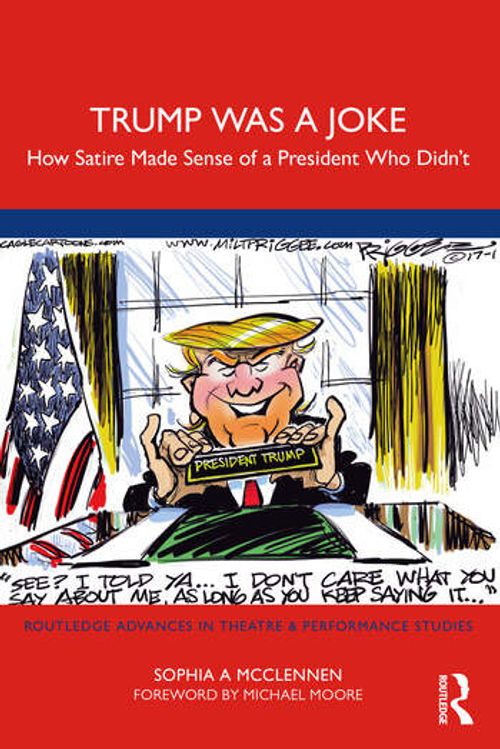

Written by a scholar of satire and politics, Trump Was a Joke explains why satire is an exceptional foil for absurd political times and why it did a particularly good job of making sense of Trump.
Covering a range of comedic interventions, it analyzes why political satire is surprisingly effective at keeping us sane when politics is making us crazy. Its goal is to highlight the unique power of political satire to encourage critical thinking, foster civic action, and further rational debate in moments of political hubris and hysteria. The book has been endorsed by Bassem Youssef, referred to as the Jon Stewart of Egypt, and Srdja Popovic, author of Blueprint for Revolution, who used satirical activism to bring down Serbian dictator Slobodan Milosevic.
With a foreword by award-winning filmmaker, satirist and activist Michael Moore, this study will be of interest to readers who follow politics and enjoy political comedy and will appeal to the communications, comedy studies, media studies, political science, rhetoric, cultural studies, and American studies markets.
“Sophia McClennen’s new book is a fantastically readable analysis of why ironic comedy has become so important in politics today. It confirms what I witnessed myself as a political comedian in Egypt during the Arab Spring: The crazier the politicians get; the more valuable political comedy becomes for the public. As I learned myself and as this book proves, when absurd politicians take power, it is hard to use reason against them, but it can be easy to use satire. McClennen convincingly shows how satirical comedy helps reason triumph over political repression. Even better, Trump Was a Joke reminds us that when you’re laughing, you can’t be afraid.”— Bassem Youssef, the “Jon Stewart of Egypt” and author of Revolution for Dummies: Laughing Through the Arab Spring
“Trump Was a Joke offers the best, most-comprehensive guide yet to the power of political satire in shaping public opinion during turbulent political times. It is a must-read account of how political satire has come to play such a dominant role in contemporary politics, especially in the era of populist leaders and the global war on truth. It does an excellent job of explaining how being seriously funny can have serious impact on keeping us sane and it shows us how satire can work as a powerful political tactic.”— Srdja Popovic, author of Blueprint for Revolution: How to Use Rice Pudding, Lego Men, and Other Nonviolent Techniques to Galvanize Communities, Overthrow Dictators, or Simply Change the World
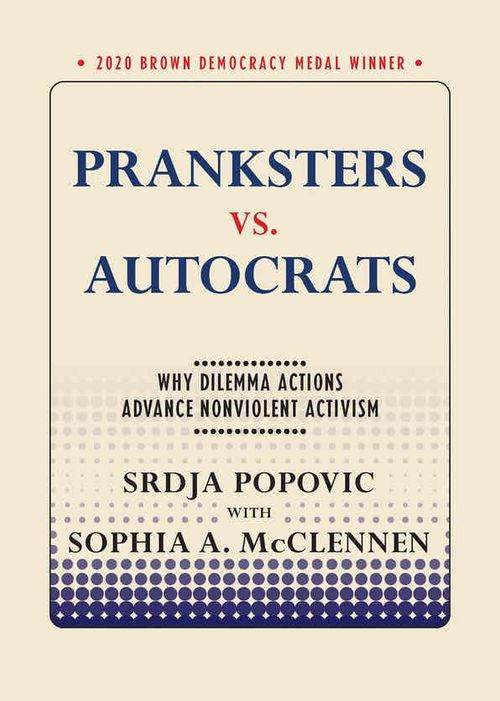
Do you want to overthrow a dictator, expose political corruption, or advance democratic goals? Pranksters vs. Autocrats presents a proven method to help advance the goals of non-violent activists. We offer in-depth analysis and a how-to guide to dilemma actions – a tactic that helps put political opponents in a lose-lose situation and gain visibility for your movement. Non-violent activists have long known that dilemma actions are especially effective, but this is the first book to offer empirical data to prove how and why dilemma actions work.
From Gandhi’s Salt March to the Arab Spring and from Estonia’s Laughing Revolution to local activism in sub-Saharan Africa, this book offers readers a diverse array of forty-four case studies that have shaped popular struggles for democracy and a wide range of human rights struggles across the globe. As you read this, we’ll explain how and why dilemma actions work and how to think like an effective organizer. If you already are an organizer, you’ll learn how to design actions that are fun, funny, and effective. Most importantly, you’ll learn about the power of creativity and wit in some of most important social change struggles of the last century.
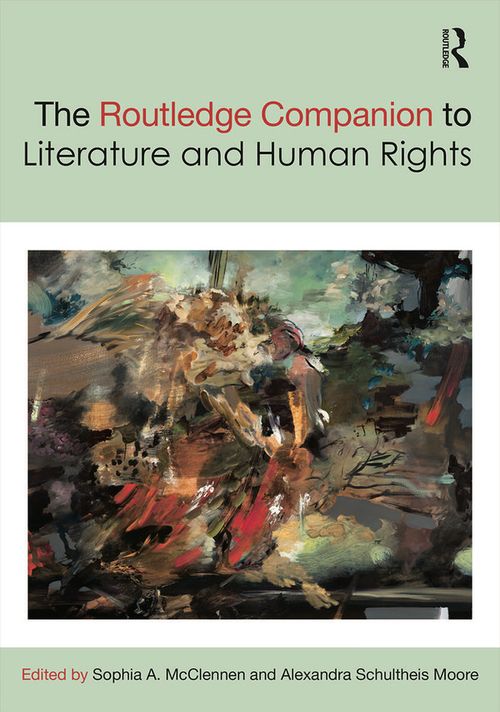
The Routledge Companion to Literature and Human Rights provides a comprehensive, transnational, and interdisciplinary map to this emerging field, offering a broad overview of human rights and literature while providing innovative readings on key topics. The first of its kind, this volume covers essential issues and themes, necessarily crossing disciplines between the social sciences and humanities. Sections cover:
- subjects, with pieces on subjectivity, humanity, identity, gender, universality, the particular, the body
- forms, visiting the different ways human rights stories are crafted and formed via the literary, the visual, the performative, and the oral
- contexts, tracing the development of the literature over time and in relation to specific regions and historical events
- impacts, considering the power and limits of human rights literature, rhetoric, and visual culture
Drawn from many different global contexts, the essays offer an ideal introduction for those approaching the study of literature and human rights for the first time, looking for new insights and interdisciplinary perspectives, or interested in new directions for future scholarship.
Do you watch satire TV? Have you re-posted a hilarious, yet biting graphic on facebook or tweeted round the clock jabs at inane politicians? Does it sometimes seem to you that Jon Stewart is a better journalist than most of CNN, Fox, and MSNBC? And were you a bit disappointed when Stephen Colbert did not actually run for president? If you or someone you know has done any of the above, then you’ll want to read this book. Is Satire Saving Our Nation? surveys the broad landscape of satire today and situates it within our nation’s history.
We are witnessing an unprecedented growth and importance of satire in the public sphere, but is that fact good or bad for the health of our nation? Co-written by a millennial and a scholar, Is Satire Saving Our Nation? shows how satire has become a central part of today’s youth culture and it explains why it might just save our democracy after all.
“A thrill ride from beginning to end! As incredibly thorough studies of the effects of political satire go, of course. This book is loaded with truthiness and it confirms my long-held suspicion that McClennen and Maisel have been secretly following me around for the past 18 years.”— J.R. Havlan, Writer for The Daily Show with Jon Stewart (1996-2014) and winner of 8 Emmys
“McClennen and Maisel move us well beyond the assumption that satire is something ‘done’ to us, recognizing instead that satire is a tool through which citizens—professional and amateur provocateurs alike—engage the political world in playful, critical, and positive ways. This most helpful book lets us see that satire is, ultimately, a language through which citizen engagement is being redefined through media activism.”— Jeffrey P. Jones, Old Dominion University, USA, Director of the George Foster Peabody Awards, and author of Entertaining Politics
“Is Satire Saving Our Nation? The authors of this important book make a compelling case. Far from turning politics into a joke, satire demands intellectual engagement, critical imagination, and a community of understanding — the very ingredients necessary for a healthy democracy. With their seemingly paradoxical, but accurate, observation that satirists may be the only ones speaking sanely in our increasingly absurd public sphere, McClennen and Maisel have challenged and enriched our thinking about what constitutes ‘serious’ politics.”— Stephen Duncombe, New York University, USA, co-founder of the Center for Creative Activism, and Yes Men collaborator
“In this superb book, Sophia A. McClennen illuminates the dilemmas of language, identity, and diaspora in ways that are refreshing and original.”— Ariel Dorfman, Duke University, author of Death and the Maiden
— John Ochoa, Latin American Research Review“Sophia McClennen’s fine Dialectics of Exile, which is not meant to be a comprehensive overview but rather a reconsideration of a particular period along thematic lines. McClennen’s book limits itself to three case studies, analyzing the works and lives of the Chilean Ariel Dorfman, the Uruguayan Cristina Peri Rossi, and the Spaniard Juan Goytisolo (the inclusion of Goytisolo places this book under the rubric of transatlantic studies, a growing academic niche in recent years). […]
“This book offers a theoretically aware argument that draws from established concepts from theories of national identity, postnationalism, and postmodernism, as well as from linguistics, feminism, and Marxism. What is unusual about it is that it does not deal with exile as a negative, traumatic event that is in effect all aftermath, as is commonly the case. Instead, it casts exile as a positive and ongoing mode of evolving cultural identity. McClennen presents exile as the initiation of an ongoing ‘dialectic,’ a word rich with Marxist, linguistic, and aesthetic resonances, all of which she mines successfully. The cultural production of exile, she rightly notes, needs to be read as a series of ‘dialectical tensions,’ rather than as static, binary oppositions where one end of the binary is favored in the interpretation (28).
“This book engages with fundamental questions head on: what is the difference between an exile and an immigrant? What is the concept of ‘homeland?’ How is the process of representation, never a simple one, complicated by displacement? “The crisis of language” of the exile, writes McClennen, ‘while revealing a crisis in the subject, does not lead to the end of representation’ (119). Rather, the literature of exile ‘often revolves around the exile’s sense of loss,’ or the ’exile’s sense of freedom once the bonds of the nation are loosened. The exile often attempts to rewrite national history and also often attempts to rewrite [. . . ] notions of community that are not predicated on the nation’ (222). McClennen’s insightful ruminations on the dynamics of exile are well-taken and their implications wide-ranging.”
“From the shores of exile, writing in Spanish has engaged in the politics of memory as un urgent challenge to the politics of oblivion. Sophia A. McClennen’s much-needed and long overdue book bridges this transatlantic dialogue. Her analysis proves that these literatures are a revision of reading that moves literature from a monological archive towards the unsheltered territory of radical dialogue.”— Julio Ortega, Brown University
“Sophia McClennen’s book responds to a pressing need to theorize an issue that involves many questions concerning notions of power, identity, and memory—all of them pivotal to the study of Hispanic culture on both sides of the Atlantic.”— Maria Helena Rueda, Smith College
“By inverting the conventional interpretive logic in which literary texts are simply made to ‘prove’ the claims of theory and setting out to show how the texts might also be capable of criticizing and even disproving certain theoretically-based critique, McClennen succeeds in a truly theoretically-based critique. I am especially impressed with her grasp of the real centrality of the concept of narration, in its broadest sense, to the question of exile.”— Neil Larsen, University of California-Davis
“Our analysis of literary exile, McClennen insists, and I agree, should transcend the facile dichotomies as to whether ’exile produces creative freedom or it traps the writer in restrictive nostalgia.'”— Paul Tiyambe Zeleza, A Modern Economic History of Africa
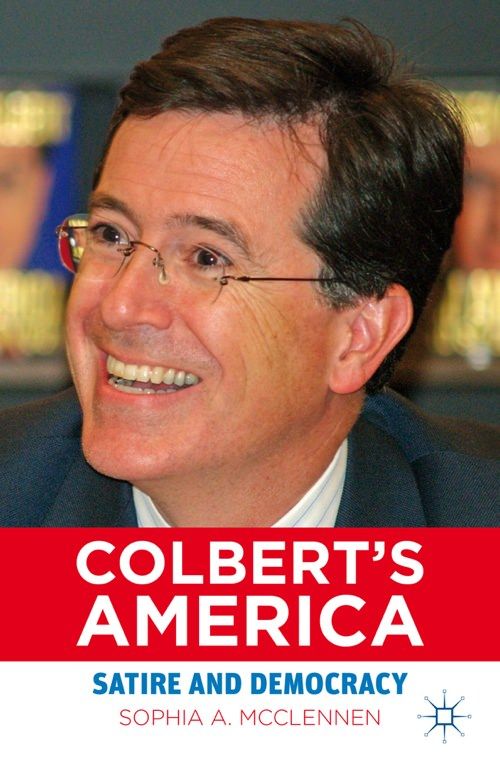
In 2005, comedian Stephen Colbert left the cast of The Daily Show for his own show, The Colbert Report, which has since become famous for satirizing personality-driven political shows like The O’Reilly Factor and Hannity. Since the show’s first episode, Colbert’s program has entertained its audience, encouraged political discourse, and stirred some of the most complacent members of society.
In her new book Colbert’s America: Satire and Democracy, Penn State professor, Sophia A. McClennen, examines how the comedy of Stephen Colbert packs enough political punch to change the way a nation thinks. The first book to cover the various themes and features of Colbert’s satire, Colbert’s America gives readers insight into the powerful ways that Colbert’s comedy challenges the cult of ignorance that has been threatening meaningful public debate since 9/11.
McClennen suggests that Colbert does more than mock pundits and politicians: he actually has helped influence a new generation of actively involved citizens. As Colbert’s America explains, satire offers the public a medium through which to express resistance to reigning political policies and social attitudes. But Colbert’s satire goes even further, offering viewers myriad ways to engage with society.
Colbert’s America also claims that the ability to speak truth to power through parody or mockery is at the heart of political satire. McClennen suggests, for instance, that Colbert’s performance at the 2006 White House Correspondents’ Dinner, when he mocked the President to his face, was a watershed moment—for Colbert’s career, for the Bush presidency, and for highlighting a new era in media. Some of these same innovations can be seen in his recent engagement with the 2012 elections.
McClennen’s book makes a number of key arguments:
- Colbert’s show has blurred the lines between parodying the news and creating the news, between mocking politics and participating in it, between having fun and making a difference.
- By combining comedy with biting social critique Colbert’s satire has redefined what it means to be a public intellectual.
- Colbert’s show both entertains and educates at the same time.
- Colbert’s in-character persona offers an especially complex version of satire—one which depends on the critical thinking abilities of his audience.
- Colbert is part of a long legacy of US satirists that used parody to advocate for democracy.
- Interactive media, including blogs, podcasts, and videos have emerged as powerful tools that help spread Colbert’s message.
- Colbert ushered in a new age in media, attracting youth culture to politics, economy, and social issues in unprecedented droves.
Despite these potential pitfalls to his form of satire, McClennen argues that ultimately Colbert’s show offers his audience a way to “amuse itself to activism.” Against claims that suggest that satire encourages cynicism, apathy, or disrespect for democracy, Colbert’s America argues that Colbert’s satire is a powerful tool for fostering civic engagement.
McClennen writes, “Watch Colbert. Night after night, he does a show where he has a bunch of fun and raises viewer awareness of a range of major social issues. Even more, he lets his viewers in on the fun. What they do after they turn off their televisions is up to them.”
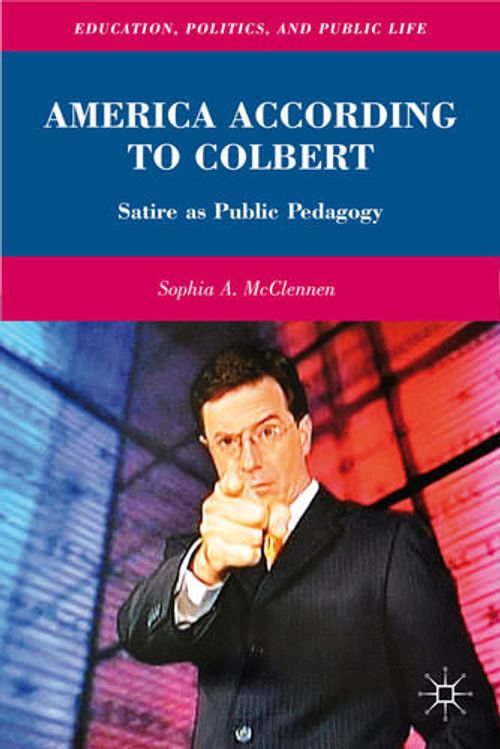
“America According to Colbert demonstrates that Colbert’s work is also a form of public education, teaching his audiences to be distrustful of power and fools, and to view all politicians, pundits, and politics itself with mistrust. McClennen’s well-written and documented study brilliantly illuminates the Colbert phenomenon and its importance for contemporary politics, journalism, and popular culture today.”— Douglas Kellner, Professor, UCLA; author of Guys and Guns Amok and Media Spectacle and the Crisis of Democracy
“Colbert’s America is beautifully readable and delightfully smart; rich in examples and conceptual frame. McClennen gives us a master class in the critical pedagogy of Colbert.”— Geoffrey Baym, Associate Professor, Department of Media Studies, University of North Carolina Greensboro
“An always insightful and often delightful reading of the most sustained and successful exercise in political satire in modern American life. Stephen Colbert would no doubt agree – well, about all but the ‘satire’ part. Let the eagle soar!”— Geoffrey Nunberg, Adjunct Full Professor, School of Information, University of California at Berkeley
Neoliberalism, Education, Terrorism: Contemporary Dialogues is a collaborative effort among four established public intellectuals who deeply care about the future of education in America and who are concerned about the dangerous effects of neoliberalism on American society and culture. It aims to provide a clear, concise, and thought-provoking account of the problems facing education in America under the dual shadows of neoliberalism and terrorism. Through collaborative and individual essays, the authors provide a provocative account that will be of interest to anyone who concerning with the opportunities and dangers facing the future of education at this critical moment in history.
“In times like these, Neoliberalism, Education, and Terrorism is essential reading for any concerned American.” — Teachers College Record
“The contributors to Neoliberalism, Education, and Terrorism call for academics to recognize and resist neoliberal economic policies and the state’s conduct of the war on terror as forces eroding what they call “progressive education” in post–September 11 America. By concretely analyzing how these forces are working to appropriate education at all levels, studies like this not only provide useful sociopolitical insight into the challenges educators face but also remind us of the need to do something about them.” — Academe
‘"America According to Colbert demonstrates that Colbert’s work is also a form of public pedagogy, teaching his audiences to be distrustful of power and fools, and to view all politicians, pundits, and politics itself with mistrust. McClennen’s well-written and documented study brilliantly illuminates the Colbert phenomenon and its importance for contemporary politics, journalism, and popular culture today."’— Douglas Kellner, Professor, UCLA; author of Guys and Guns Amok and Media Spectacle and the Crisis of Democracy
“The article move deftly between high theory and practical politics, guiding the reader through an impressive range of material (poetry, prose, music, film, and photography) with broad historical scope (the French Revolution, post World War II decolonization, the ‘Global War on Terror’)—all the while retaining a strong sense of cohesion and unity of purpose. This is a spirited collection, simultaneously provocative and rigorous. It is not only an urgent appeal for engaged public scholarship, but also a first-rate example of it.”— James Dawes, Macalester College, author of That the World May Know
“Some suggest that comparative literature is a dead discipline. This book proves them wrong by showing the engaged responsiveness of post-contemporary comparativism to current social and political problems. Rather than fashioning itself as an alibi for Western imperialism, the volume reveals the emerging role of comparative literature and comparative cultural studies as an active agent in progressive social understanding and change—particularly in an ‘age of terror.’”— Jeffrey R. Di Leo, University of Houston-Victoria, author of Academe Degree Zero: Reconsidering the Politics of Higher Education
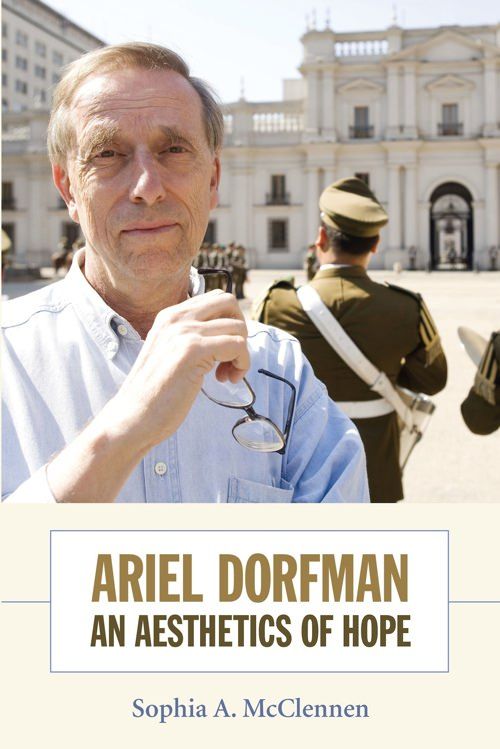
Ariel Dorfman: An Aesthetics of Hope is a critical introduction to the life and work of the internationally renowned writer, activist, and intellectual Ariel Dorfman. It is the first book about the author in English and the first in any language to address the full range of his writing to date. Consistently challenging assumptions and refusing preconceived categories, Dorfman has published in every major literary genre (novel, short story, poetry, drama); adopted literary forms including the picaresque, epic, noir, and theater of the absurd; and produced a vast amount of cultural criticism. His works are read as part of the Latin American literary canon, as examples of human rights literature, as meditations on exile and displacement, and within the tradition of bilingual, cross-cultural, and ethnic writing. Yet, as Sophia A. McClennen shows, when Dorfman’s extensive writings are considered as an integrated whole, a cohesive aesthetic emerges, an “aesthetics of hope” that foregrounds the arts as vital to our understanding of the world and our struggles to change it.
To illuminate Dorfman’s thematic concerns, McClennen chronicles the writer’s life, including his experiences working with Salvador Allende and his exile from Chile during the dictatorship of Augusto Pinochet, and she provides a careful account of his literary and cultural influences. Tracing his literary career chronologically, McClennen interprets Dorfman’s less-known texts alongside his most well-known works, which include How to Read Donald Duck, the pioneering critique of Western ideology and media culture co-authored with Armand Mattelart, and the award-winning play Death and the Maiden. In addition, McClennen provides two valuable appendices: a chronology documenting important dates and events in Dorfman’s life, and a full bibliography of his work in English and in Spanish.
‘“Ariel Dorfman: An Aesthetics of Hope is a complete life-and-works study of Dorfman, one of the premier Latin American writers. Surprisingly, it is the first full-length English-language study of the author. I learned a great deal from this rich and compassionate text. Sophia A. McClennen approaches Dorfman with measured affection and a sharp critical eye. She has written a model study: the biographical information provides context for the creative work, and her analysis of the creative work avoids excessive plot summary, while still giving the reader unfamiliar with a given text enough information to understand the argument.”’— Debra A. Castillo, author of Redreaming America: Toward a Bilingual American Culture
‘“Sophia A. McClennen is a writer of extraordinary gifts and one of our most promising intellectuals. In Ariel Dorfman: An Aesthetics of Hope, she not only gives human form to a poetics and politics of hope, but also offers us a brilliant and compelling narrative of Ariel Dorfman’s work and life, revealing the courage and costs involved in taking risks, embracing civic courage, addressing the suffering of others, and living in a world in which democracy must never be taken for granted. Beautifully written and brilliantly argued, this is a book for everyone who believes that hope is the poetry of politics.”’— Henry A. Giroux, author of Hearts of Darkness: Torturing Children in the War on Terror
“Controversial, relentless, provocative, and astoundingly creative, Dorfman has been the most single-minded culture critic of the latter part of the 20th century. McClennen’s critique is, in turn, an exemplary analysis of Dorfman’s remarkable practice of thinking through crisis. An invaluable addition to the literature on literary and cultural studies. Essential.”— K. M. Sibbald, Choice
“[A] welcome overview of Ariel Dorfman’s huge corpus of literary, journalistic, cinematographic, and critical work. … McClennen’s book … makes the reader aware of the monumental and diversely composed project that is Dorfman’s corpus.”— Robert F. Barsky, Modern Drama
“[T]his remarkable study makes a valuable contribution for those interested in Dorfman’s life and works and for anyone considering the difficult questions of how literature can effectively engage with the world in which we live, of what role more experimental art can play in the age of mass media, and of how language can engage with trauma and memory.”— Victoria Garrett, Hispania
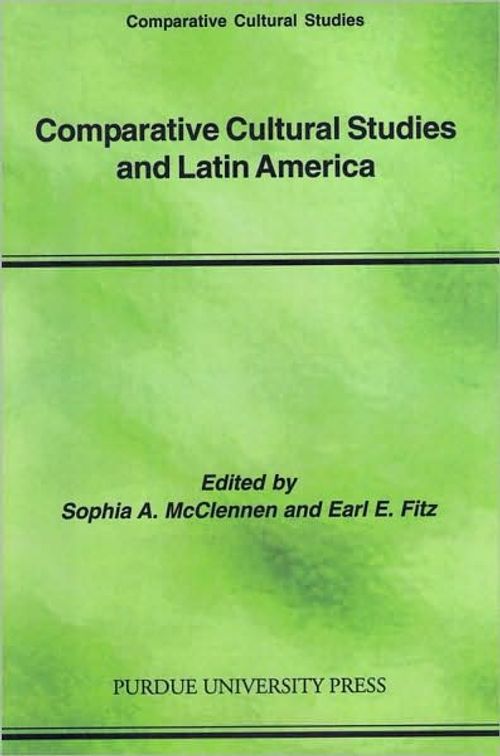
“In this new collection of essays, some of which read like manifestos, Sophia A. McClennen and Earl E. Fitz attempt to rectify the persistent and altogether unwarranted tendencies among some comparatists of privileging European literatures (especially those written in English, French, and German), as well as classifying Latin American literature written in Spanish and Portuguese as “peripheral” and therefor not nearly as worthy of study. The twelve essays represent a wide range of investigation and critical inquiry into Latin American literature, and will undoubtedly spark debate—and perhaps self-examination—among comparatists.”— Daniel John Nappo, Univeristy of Tennessee at Martin in Hispania vol. 88 no. 4, 2005, 771-73.
“In this essential, and soon-to-be controversial, volume, Sophia A. McClennen and Earl Fitz have gathered together some of the most important and eloquent scholars working in the US and Canadian academy today.”— Debra Castillo, Cornell University